Grant available for insulation?
Find out instantly whether your property may be eligible for an insulation grant.



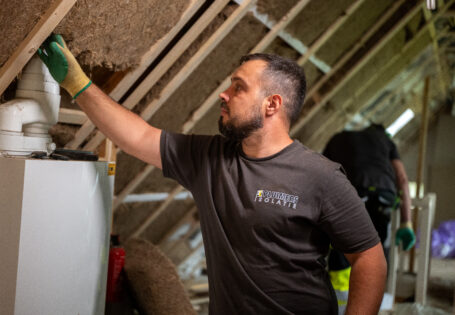
There are several ways to insulate a loft floor. In many cases, we drill small holes in the timber floor and fill the joist cavity with mineral glass wool, using a technique similar to cavity wall insulation. For unused lofts, we blow insulation directly onto the floor to maximise heat retention.
 alt=""/>
Find out instantly whether your property may be eligible for an insulation grant.
Loft floor insulation is an effective way to reduce heat loss and make your home more energy-efficient. We insulate loft floors with mineral glass wool, a material that offers excellent thermal and acoustic insulation. It helps create a more comfortable indoor environment while lowering your energy bills and making your home more sustainable.
Do you have a question or would you like to arrange a free, no-obligation consultation? You can contact us by phone or schedule an appointment using the consultation button.
Loft floor insulation involves insulating the timber floor of a loft or attic space. This type of insulation is commonly installed when the loft is not used as a living area but is intended to prevent heat from escaping through the roof. By insulating the loft floor, more heat is retained in the living spaces below, resulting in lower energy bills and a more comfortable indoor environment. Pluimers Insulation uses a specially developed mineral glass wool for this application or a bio-based insulation material called Greenfloc Cellulose. One of the biggest advantages of loft floor insulation is that it is a relatively simple and cost-effective way to save energy when the loft is not used as a living or sleeping area.
Loft floor insulation involves insulating the timber floor of a loft or attic space. This type of insulation is commonly installed when the loft is not used as a living area but is intended to prevent heat from escaping through the roof. By insulating the loft floor, more heat is retained in the living spaces below, resulting in lower energy bills and a more comfortable indoor environment. This form of insulation is particularly suitable when the loft floor is easily accessible and the loft is empty. Small holes are drilled between the joists, allowing the cavity between the floor below and the loft floor to be filled with insulation. Once the insulation has been installed, the holes are neatly sealed with cork plugs.
A timber frame is a construction method in which a building is built using a framework of timber beams. This framework forms the structural support of the building and is often combined with insulation materials such as glass wool to improve energy efficiency and thermal performance. Supafil Timber Frame or Supafil Loft glass wool is commonly installed between the timber joists to provide excellent thermal insulation. Glass wool is a widely used insulation material because of its outstanding insulating properties, affordability, ease of installation, non-combustible characteristics and excellent sound-insulating performance.
In addition to glass wool, Pluimers Insulation also offers Greenfloc Cellulose, a bio-based insulation material that is not only a sustainable choice but also financially attractive thanks to additional government grants. Greenfloc cellulose insulation is made from recycled cellulose fibres, such as recycled newspaper, and is treated with mineral salts to provide fire resistance, protection against pests and mould, and excellent moisture-regulating properties.
Several grants and funding schemes are available in the Netherlands to help reduce the cost of loft floor insulation. These include national government grants as well as local schemes offered by municipalities and provinces.
Loft floor insulation can have a significant positive impact on a property’s energy label. An energy label indicates how energy-efficient a home is, and improved insulation reduces the amount of energy required for heating and cooling. As a result, installing loft floor insulation can help achieve a better, more energy-efficient energy label.
The cost of loft floor insulation depends on the insulation material, the thickness of the insulation layer and the size of the loft floor. When the insulation is installed by a certified insulation company, you may be eligible for government grants. Loft floor insulation can also deliver substantial savings on your energy bills. Depending on the size of your home and the level of insulation, you could save between €200 and €400 per year* on energy costs. This means that the investment can typically be recovered within 5 to 10 years.
*Source: Milieu Centraal
The choice between loft floor insulation and roof insulation depends on how your loft is used. The specific characteristics of your property also play an important role. Both insulation methods are highly effective, but they offer different advantages depending on your situation.
This page was last updated on 20 April 2026. We make every effort to ensure that the information on this page is accurate and up to date. If you notice anything that is incorrect, please let us know. No rights can be derived from the content of this page.
Government grants are also available for loft floor insulation. Curious how much you could receive? Visit our grants page. Is your roof suitable for roof insulation?
Request your free consultation and quote today!
Call us directly or request your free quote online using the "free quote" button.
Our insulation advisor will be happy to visit you for a free, no-obligation consultation.
Yes, I'd like a free consultation!